blogphoto

blogphoto
Showing posts with label South Africa. Show all posts

Tuesday, August 27, 2013

Reflections on Access to Health Care


Memory: November 2012

I wake up in the middle of the night with stomach cramps and nausea. I stand up and walk from my sister’s room to one of the bathrooms in my family’s home in Canada.

As I walk I feel faint and call for my Mother. I then loose all control of my body, collapsing onto the soft carpet floor.

I come to as my mother drags me to the bathroom and helps me sit upright. In minutes, two paramedics are hovering over me. They wait while my Mother cleans me (sorry about that Mom) and then I’m on a stretcher being hoisted into an ambulance. The ambulance ride is less than 5 minutes.

I’m wheeled through the emergency room and immediately get a bed in the emergency ward. I’m seen quickly by a doctor and hooked up to state of the art machinery. They take samples of everything you can imagine, conduct X-rays, give me an ultrasound and monitor me constantly.

Within hours, my father is on a plane home from Florida and my Mom takes the day off work to be with me. I was discharged late the next day.

As I lay on that hospital bed I felt angry for competing reasons. At first I was angry to be in the hospital, to be sick, to feel helpless and confused because I didn’t know what was happening. I wanted to go home.  

Then I thought about what would have happened if the same thing had occurred a month before when I as living in Malawi…

... and THEN I thought what would have happened if I was a ‘typical’ Malawian women.

In Malawi, the GDP per capita is $900 USD per year and 80% of the country lives in rural areas. Thus, the ‘average’ Malawian woman is living in poverty in a rural area. At the age of 27, I would most likely be married with a few children and have significant family responsibilities to attend to. I would likely have collapsed onto the mud or cement floor of a small makeshift brick or thatch house without electricity or running water in the home.

Just months previous, we had been delivering bicycle ambulances in a rural area. While thanking us, one of the carers who would be using the bike to transport sick people to the hospital told us that someone he knew had died the previous week because they couldn’t get him to the clinic.
Even if the person who passed away HAD been able to get to the clinic, they certainly wouldn’t have had anything close to the quality of treatment Oakville Trafalgar Hospital in Canada had.

Alinafe Hospital in Salima District
Reflecting one what would have happened to me if I had been born into a different body on a different piece of land, I felt simultaneously angry, lucky and sad.

In addition to being able to access a quality hospital, Mom had a good job that allowed her to take the day off work at no cost. Dad was able to buy an emergency plane ticket from another country to be with me.

The cost of my day in a state of the art hospital in a country where private care does not exist?

$0.

How did I get so lucky?

*** 

Memory: July 2013

My friend calls me one Saturday morning, telling me that she is sick with Malaria after a trip to Mozambique. She asks if I wouldn’t mind taking her to the clinic – she isn’t responding well to the medication she was prescribed. We go to one of Cape Town’s clinics where her international student medical insurance is accepted.

While at the clinic, her condition deteriorates quickly. When the doctor sees that her, her temperature is over 41 degrees. We are told that she must go to the emergency room immediately and then gets asked if her medicare covers private hospitals? (A note on South Africa’s health care system: there are essentially two of them – a private one which the richest approximately 20% of the country accesses and a public one used by rest who don’t have medical coverage or the ability to pay out of pocket.) My friend isn’t sure what is covered so we get referred to the closest public hospital.

By the time we get to the hospital, she is unable to walk. A porter comes with a wheelchair to take her to the emergency room.

I park and make my way inside to find her slumped alone on a chair, waiting in the crowded room to be triaged. After pushing my way to the triage station and insisting they see her immediately, they triage her ‘red’ (high priority) and she is finally taken to be seen by a doctor in the emergency ward.

We wait for hours while they take a blood test and eventually give her medication. They say if she can hold the pills down without vomiting, they will discharge her – they don’t have enough space to keep her there.

I’m asked me to leave the area – visitors aren’t allowed. In response, I search my bag, find an orange and smile at the security guard while passing it to him.  
Just before they discharge her, I give her juice and tell her to chug it – I’m hoping she will vomit because I’m terrified that they will kick her out of the hospital.

Just before discharging her, the doctor looks down again her file. His expression changes - her kidneys aren’t functioning properly.

I’m on her phone frantically trying to communicate with her family in America and at the same time, talk to her South African medical insurance. I call them on repeat, but it is the weekend and I keep getting passed to different places. No one can tell me if her plan covers a private hospital. Choking back tears, I tell the woman on the phone that my friend is very sick and that its pretty shitty that she can’t tell me if I can get her private care. She tells me there is nothing she can do and hangs up the phone.

Next I’m on the phone with my friend’s sister, trying to figure out if the situation needs, if they would like to transfer her to a private hospital at their own expense.

In the corridor outside the emergency room, I stand stunned. I have a million questions running through my head but the main one is ‘Should I try to get her to a private hospital?’ and ‘Can I afford it if it comes to that?’.

Never in my life have I had to ask myself these questions.
Never have I had to consider the cost of healthcare when making a decision. 
Never have I had to do a cost-benefit analysis with regards to a human life.

Rarely have I felt so lucky to be Canadian.

(Note: my friend is alive and after 3 weeks in the hospital has gone back to the States. We later found out the severity of the Malaria – she is lucky to be alive. She has lost most kidney function and is now in need of a transplant.)

*** 

Memory: June 2013

I’m sitting chatting with a friend in a small restaurant a few hours outside of Cape Town.
She is more educated than I am and has access to well paying work as a journalist.

She casually mentions that before leaving for Cape Town she had to decide between getting a polyp removed from her cervix or getting a mammogram. She is pleased that she chose the cervix operation because her periods are much less painful now.

My fork freezes mid-way towards my face. My eyes well up as she looks at me questioningly.

YOU HAD TO CHOOSE WHICH MEDICAL PROCEDURE TO GET?!

I had minor surgery on my cervix a few years ago and I’ve known for years that I will start getting mammograms when I turn 40.

It never crossed my mind that I would have to PAY for either.

It never occurred to me that I would have to pick and choose health services based on what was in the piggy bank.

Hell, my piggy-bank and health services don’t even fit in the same category in my mind.  

Despite hearing about health care debates in the States and hear-say on Americans making the trek North in hopes of accessing Canadian health services, the reality of the country less than 100km away from my home neverfaithdp3 really hit me.

Not to say our health care system is perfect. Not everything is covered and access to health services for marginalized peoples isn’t near as good as what I’ve had the privilege of accessing. I’ve had to wait months to get an appointment for an annual physical.

The concept of having to choose between cervical surgery and a mammogram completely floors me. 

*** 

Memory: November 2011

I’m sitting reading the newspaper in Malawi. The fuel crisis continues to rage and neither diesel or petrol are available at the pump.

Black market prices are skyrocketing (around $3 USD equivalent per litre if my memory serves me correctly). It is next to impossible to get a taxi cab, and if you can, it is close to prohibitively expensive.

I’m used to hearing about the crisis and seeing huge lines at the pumps on the odd day when a shipment comes in. I’m used to hearing about cars damaged from black market fuel which has been mixed with cooking oil or water.

I’m also used to the frequent (oftentimes daily) power outages.

Despite having become used to the fuel and energy shortages, this newspaper article put things in a completely different perspective. It was a story about 3 lives lost in the city in which I was living.

One woman died at home because the ambulance didn’t have the fuel necessary to pick her up.

The other woman was at the hospital giving birth and developed a complication. She was in emergency surgery when the power went out. Since there wasn’t any fuel, the backup generator didn’t go on and both her and the baby died.

The relationship between infrastructure, economics and access to hospital services had never crossed my mind. To have a power outage in a hospital was obscure enough – loosing two lives on one operating table because there isn’t fuel for the back up generator?

*** 

Coming from a country with one of the best health care systems in the world, these past 2 years have been a huge eye-opener for me. Access to health services is immensely important, and very few people are as lucky as I in this regards. Despite firmly believing that health care is a right, the daily realty for many people across the world is much different for many economic, social, ideological and political reasons. 

Friday, July 19, 2013

Vacation – Part 2: Durban


After hanging out in East London, I decide to continue on alone to Durban. This coastal city is situated in the province of KwaZulu-Natal, home of the Zulu nation.  

Durban - Look to the East Coast!

On the 8-hour bus ride, a few really cool things happened:

1) Staring out the window, I felt something familiar. I oftentimes miss Malawi, the landscape and the earthy, basic beauty of the place.

In big, cosmopolitan Cape Town, I often long for this feeling. Seeing the rural landscapes pass by, I feel like I am back in Malawi.

My Aunt Sandra once told me that as a child, she believed that it wasn’t the car that moved people places. Instead, she thought you would get in the car, close the doors, and then the world would somehow move around you.

I felt the same way on this bus trip (as ego-centric as that may sound!). I plunked myself down on a seat near a window and the world morphed around me, offering landscapes that I could never imagine. How could I, with such little effort, have such a nice experience sitting looking out the window? 

2) The bus stops for a while due to construction. I look down at my phone and use the Facebook ‘check-in’ function to figure out where I am. Turns out we were stopped no place other than Qunu, the place where Nelson Mandela grew up!

3) Somewhere past Butterworth (yes, towns here are named after the colonizer too, despite seeming very away from their namesakes!) a woman gets on the bus and sits next to me.

The first thing that strikes me about Jazz is that she looks like a character from the book I was reading, Chimamanda Ngozi Adichie’s Half of a Yellow Sun. The beautiful character Olanna is described in this way:

Her oval face was smooth like an egg, the lush colour of rain- drenched earth, and her eyes were large and slanted and she looked like she was not supposed to be walking and talking like everyone else; she should be in a glass case like the one in Master’s study, where people could admire her curvy, fleshy body, where she would be preserved untainted.’
I feel shabby next to her in my makeshift head wrap, crumpled travelling clothes and pimple inflicted face.

She smiles and talks to me anyways. Turns out that Jazz is going home to Durban after visiting her family in the Eastern Cape. Her Dad is a town counselor and her Mom a teacher (sounds a little familiar right?!).

She asks where I’m staying and when I tell her the name of the cheap backpackers where I booked a dorm bed she looks very concerned. You’re going to be eating cockroaches all night there! How would you feel if I invited you to stay with me instead?

Technically, I know it isn’t the smartest thing to stay with an utter stranger in a city you’ve never been to. Especially when you are a solo female traveller in a very unequal country where ‘crime’ seems on the tip of everyone’s tongues.

At the risk of sounding trite, I disregarded that technicality and followed my intuition. And I’m glad I did.

Jazz is finishing her studies in Durban. She lives with her brother and sister who were gone for summer vacation. I had a room to myself, complete with a double bed. I woke up in the morning to a stunning view of Durban.

View from 'my' room - Durban


Jazz and I - at the Ocean 

The next few days, Jazz shows me around the city and I spend time hanging out with her and her boyfriend Lunga. They adore each other and I adore being around wonderful people who are positively in love. Having recently come out of a tough break-up, they remind me that love exists, and I feel hopeful and happy in their company.

Jazz and Lunga

The first morning she prepares breakfast for us and shows me how she makes eggs. The next day I make French toast for them, and the day after I teach them how to make it on request. Despite having to substitute corn syrup for maple syrup, they still liked it and wanted to learn! 

One of the things I love the most about travelling is this type of exchange. As trivial as it may sound, I love sharing breakfast making techniques and other little shards of lives.
I’m always floored by how willingly people share and open up to a foreign, scrungy traveller like myself.

I arrive back in Cape Town and am greeted at the airport by my dear friend Marina from the States. I am warmed, humbled and astounded by the love that I have been surrounded by here. This trip was exactly what I needed.

On the way back to Cape Town

Tuesday, July 16, 2013

Trip to Eastern Cape Province


A few years ago, I interviewed health care workers in townships surrounding Cape Town as part of a volunteer project. These health care workers, called Patient Advocates were truly inspiring individuals who work tirelessly to support people living with HIV in taking their medication and living healthy lifestyles.

Eastern Cape
Most of them, like many other South Africans in this area, hail originally from Eastern Cape Province.

A mostly rural area, Eastern Cape is said to be the home of the Xhosa people. It also happens to boast some of South Africa’s most famous, including the first and second presidents of democratic South Africa, Nelson Mandela and Thabo Mbeki as well as founder of the Black Consciousness Movement Steve Biko (just to name a few!).

Needless to say, I've been wanting to visit the Eastern Cape for some time. 

I was lucky to receive an invite from a friend to join him on a trip home to East London (one of Eastern Cape's major cities) for a visit. There ended up being four of us travelling together, two friends from East London, a German expat and myself.

The 18-hour bus ride in itself was very eye opening. We move into more rural areas and pass through smaller towns. Siseko points out young Xhosa initiates wearing blankets with faces painted white, walking along the side of the road.

It felt new and familiar at once – in some places the level of development made me think of a less populated Malawi. 

One of my favourite things in the world is travelling overland to new places - I am always giddy with excitement and childlike as I press my face up the window to take in the new surroundings.

View from the bus window - Eastern Cape Province

East London is situated on the Indian ocean. The waterfront is beautiful and the weather more temperate (a treat after Cape Town winter). Rather than playing tourist as I usually do upon arriving in a city, I went along with whatever my local friends were doing - which was a lot of hanging out (and a lot of fun!).

East London
Street vendors posing for a picture - East London

One highlight was going to a Chisa Nyama, which is a barbeque restaurant. You buy raw meat from the attached shop and give it to the cook to have it braaied (barbequed). There are picnic tables to sit at, big bottles of beer to wash the meat down and loud, fantastic music.

Cook at Chiya Nyama, East London
Braai @ Chiya Nyama
I also stayed in a township for the first time which was both an eye-opening and heartwarming experience. People were extremely friendly and welcoming. A walk through the location quickly turned into hours hanging out on the street and chatting. The day was a beautiful blur of people blasting music from their cars, greetings, conversations and laughter.


The last evening, we visited another home and were met with (yet again) wonderful hospitality. We stayed up late into the night dancing in the living room to South African music (a mixture of old freedom struggle songs and newer stuff). What a beautiful glimpse into a different side of South African culture and life. 

Ewonke busting a move
Below are some pictures of our time in East London, most taken by Siseko in the community where he grew up. 


Owner of Lungi's Tavern - She invited me in to chat and hang out with her grandchildren (below)


Tumi


Following a few days in East London, I continued on alone to Durban (next post!).

Monday, June 17, 2013

A day in Khayelitsha


Marina @ HubSpace Khayelitsha

My friend Marina and I met two very interesting local entrepreneurs a few weeks back.

We went to check out HubSpace Khayelitsha - a new project they are working on in one of South Africa’s biggest townships. 

Khayelitsha is second in size only to Soweto with an estimated population of 1.2 million. Khayelitsha translates as 'new home' in isiXhosa and in addition to those who were born there, is home to many people who have migrated from Eastern Cape province, other areas of South Africa and increasingly other parts of Africa. It was my first time to Khayelitsha and it served to be a very interesting day.

Many entrepreneurs in township spaces don’t have access to a formal office area. In this context, the logistics of administration and gaining credibility are sometimes barriers to success. HubSpace is a solution to this problem – they rent out areas on an hourly, daily, weekly monthly or annual basis where entrepreneurs can access a phone, printer, internet, etc. 

It was a great set-up and I thoroughly enjoyed my free trial there that morning. 

Seko & Meli - Hubspace Khayelitsha

Working @ Hubspace Khayelitsha


The day also proved interesting for another reason. While driving in, I saw men on the side of the road holding jerry cans. I wondered what was in the jerry cans but didn’t think much of it.

At the space, we heard singing and looked out through the window. People were holding signs directly below us. The premier of Western Cape Province, Helen Zille was scheduled to be arriving for an event. 

Protest starting... view from the window

We heard warning shots being fired into the air. Outside, police threw someone in a van and it smelled realllyyyy bad. Turns out the protest was on sanitation in the area. Many people don’t have access to flush toilets and have to share portapotties amongst many people. 

In protest, they threw jerry cans full of poo on the Premier’s convoy.

Poor living conditions are a daily reality for many South Africans and an ongoing part of the sad legacy of apartheid.

Protest Aftermath (Photocred to Marina)

Every day I am here I learn something and become more aware of how little I know.  

This day in Khayelitsha (seeing a wonderful local entrepreneurship project and a protest for access to basic sanitation) stands out to me as an illustration of the incredible complexity and contrast present in South Africa. 


Wednesday, June 12, 2013

A photo walk through Woodstock, Cape Town


Woodstock (Table Mountain and Devil's Peak in the background)


Art & Words
Cape Town is a sprawling city, containing many ‘suburbs’ that used to be small towns in themselves. Woodstock is one such suburb, about 1 kilometer from the city centre (or ‘town’ as it is called here’).

My introduction to Cape Town two years ago was in Woodstock. This is where I lived and volunteered for a month and a half on my first visit to the city. Woodstock continues to draw me back – I find myself coming back to this area often.

It is a fascinating and intense space:

Van taxis swerve and squeal through traffic while the conductors shout their destinations. 
Vendors line the streets selling their wares.
Funky cafes, art galleries and antique shops abound.
Devils Peak provides a stunning background to the myriad side streets adorned with brightly painted houses.
Pigeons and the occasional scroungy dog pick through the mounds of trash. 
Circles of barbed wire line virtually every fence.


Beauty & barbed wire


Woodstock has a unique history as one of the areas that remained integrated during apartheid, escaping the forced removals that saw its neighbouring suburb; the once vibrant District 6 bulldozed and classified a ‘white only’ area. Today it continues to be a diverse space.

Elaine was a resident of the former District 6. She was forcibly removed during apartheid and moved to Woodstock years ago to be close to where she grew up. 
Cape Town has been selected by the International Council of Societies of Industrial Design (ICSID) as the World Design Capital for 2014 (the last two awards were giving to Helsinki and Seoul). The objective of the award is to recognize and showcase cities that are dedicated to using design for social, cultural and economic development.

Woodstock really stands out to me in this regard, using design for social, cultural and economic ends.  

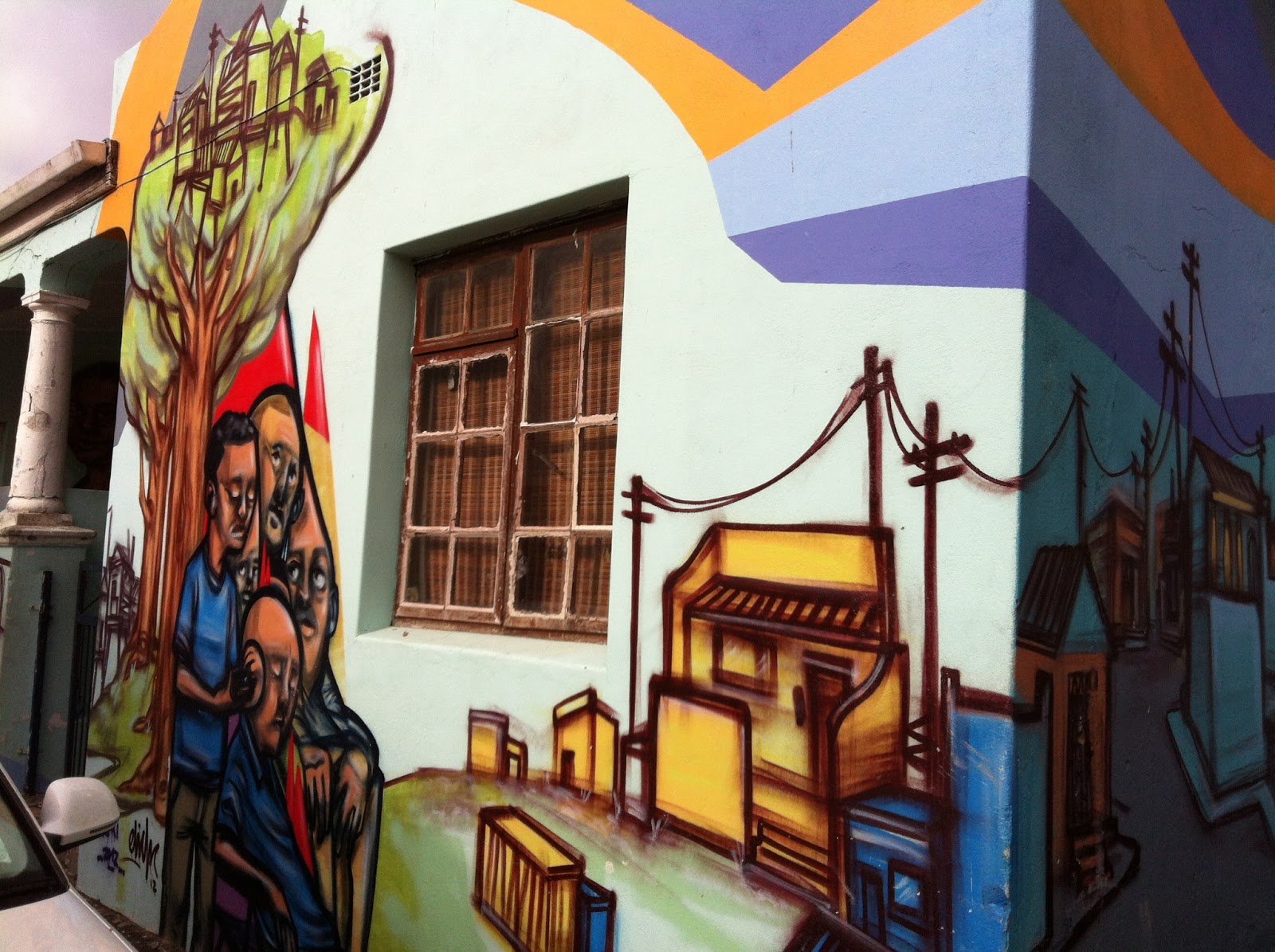
Although it is a microcosm of the inequality present throughout South Africa, I believe that this place has something really special. It is full of beautiful and uplifting street art and crammed with visuals of hope, vibrance and beauty.

The graffiti is a combination of esthetics, inspiration, politics and poetry.

Here are some offerings from today’s stroll through Woodstock with a camera...


Feeding the Pigeons


You've Got the Whole World in Your Hands


Part 1 - Evolution (?)

Part 2 - Evolution (?)

Part 3 - Evolution (?)


Removing the greyness from the soul is the job of musicians, artists and poets...


Wearing their hearts on their sleeves

Spray Paint Poetry


An imagined window

Imagined windows


Outer wall of Children's Home

Outer Wall of Children's Home


@ a Children's Home